Wall-Hung vs. Floor-Mounted Toilets: Which Fits Your Chicago Bathroom Remodel?
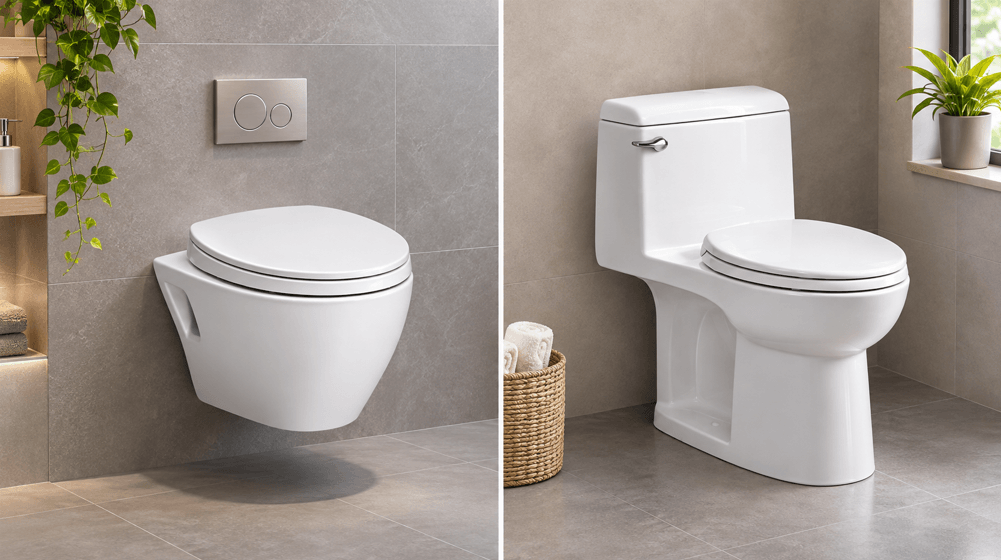
The wall hung vs floor mounted toilet question comes up on nearly every bathroom remodel we hear about. Both designs work well, and the right one depends on your layout, existing plumbing, wall construction, budget, and renovation scope. We have helped trade pros and DIY homeowners sort through it for more than 30 years.
If you’d like to compare both styles in person, stop by our Irving Park Rd. showroom or browse our toilets online first.
Wall-Hung vs. Floor-Mounted Toilets: The Quick Answer for Chicago Remodels
A floor-mounted toilet is often the practical choice for a straightforward swap, especially when the existing drain, water supply, and layout can stay where they are. It’s familiar, and it usually keeps the project simple.
A wall-hung toilet may suit you better when floor space and a streamlined look matter, and when the wall and budget allow. It’s a concealed, structurally supported system, while a floor-mounted fixture generally installs more simply and keeps tank components easy to reach.
Price the complete installed system rather than the bowl alone. Carrier parts and plumbing changes will affect the total, and so will wall finishing. Future service access matters too.
How Each Toilet Type Works
Many readers ask, “How does a wall-hung toilet work?” The short answer is that the support shifts from the floor to a carrier inside the wall.
Floor-Mounted Toilets: Familiar Design and Simpler Plumbing
A floor-mounted toilet has a bowl and a tank, and it sits over a floor flange. The bowl rests on the finished floor and connects to the drain through the flange, which is anchored to the structure. A two-piece model has a separate tank and bowl, and it’s among the most common types in the U.S. A one-piece fixture combines them. Floor-mounted toilets are generally considered relatively easy to install and maintain.
Wall-Hung Toilets: Carrier, In-Wall Tank and Flush Plate
A wall-hung toilet suspends the bowl on a concealed carrier. The tank sits inside the wall, and the flush plate is the only visible control. This is the “floating toilet” look many people want. The bowl needs the carrier for support, since drywall or tile can’t hold it.
A TOTO in-wall tank system is a separate component, so the compatible bowl and flush plate are purchased separately. Wall-hung designs also differ from back-to-wall toilets, which sit close to a wall but still rest on the floor.
Side-by-Side Comparison: Wall Mounted Toilet vs. Standard Toilet
For a wall mounted toilet vs. standard toilet comparison, this table summarizes the differences in plain terms. Verify structural ratings, flush specifications, and compatibility for the exact products you’re considering.
| Feature | Wall-Hung Toilet | Floor-Mounted Toilet |
|---|---|---|
| Installation Complexity | Generally requires coordinated work inside the wall | Can often keep existing connections |
| Wall/Framing Requirements | Needs framing and anchoring suited to the carrier | Typically no special wall support |
| Space and Look | Suspended bowl with concealed tank | Wide range of traditional and contemporary styles |
| Cleaning Access | No floor-level base to clean around | Requires cleaning around the base and floor junction |
| Seat Height Flexibility | Set at installation within the manufacturer’s range | Determined mainly by the model selected |
| Maintenance Access | Through the flush plate, with system-specific servicing | Visible tank that is easy to reach |
| Budget Considerations | Typically higher upfront | Often a simpler budget path when plumbing stays suitable |
| Best Applications | Substantial remodels with open walls and design goals | Direct replacements and tighter project scopes |
Space, Style and Cleaning: Where Wall-Hung Toilets Stand Out
When people weigh the pros and cons of wall hung toilets, the advantages usually come down to space and cleaning. A floor-mounted toilet can still look sleek, since skirted and contemporary models reduce crevices without a suspended installation.
Space-Saving Design and Visual Openness
A suspended, skirted bowl with a concealed tank can make a bathroom feel less crowded. The flush plate comes in multiple styles and finishes, so it can coordinate with surrounding materials. This is why many people consider a wall-hung model a space saving toilet.
Actual savings depend on bowl projection and the finished wall assembly, since a deeper wall or added enclosure can offset some of the gain. Compare bowl projection figures when you narrow your choices, and our showroom team can help you compare them side by side.
Cleaning Access and Height Flexibility
Concealing the tank and supply connections removes exposed components around the toilet, which can make cleaning easier. Routine care still applies to the bowl, seat, underside, and wall connection, using manufacturer-appropriate products.
A wall-hung bowl lets installers set seat height within the manufacturer’s range, which can help with accessibility planning, though the height is fixed once installed. Factor in finished-floor level and seat thickness when planning that height. Some TOTO wall-hung models offer adjustable mounting height, and select models use a glaze designed to resist waste sticking.
Our showroom carries TOTO wall-hung toilets, including the TOTO Aquia Wall-Hung Toilet and TOTO Maris Wall-Hung Toilet, which you can compare in person.
Rough-In, Framing and Installation: What Changes in a Remodel
Rough-in is where the two styles part ways. A compatible floor-mounted replacement may preserve existing locations. A wall-hung conversion can require rerouting the toilet’s waste connection and coordinating drain routing, water supply, bowl elevation, and flush plate position before the wall closes.
A full remodel usually offers better access for this work than a fixture-only swap in a finished bathroom. If you’re planning one, bring your measurements to our showroom and we can talk through compatible bowl, carrier, tank, and flush plate combinations.
Existing Plumbing, Wall Construction and Chicago Building Factors
Chicago’s older housing stock, from bungalows, two-flats and greystones to mid-rise condos, often brings conditions worth checking early, including basement and slab conditions, existing wall depth and cast iron stacks.
Chicago’s code requires wall-hung bowls to be supported by a concealed metal carrier attached to the building’s structural members, so strain isn’t transmitted to the plumbing connection, and the carrier must conform to the ASME A112.6.1 standard. In-wall systems are designed for particular wall constructions, such as standard or deeper stud walls and pre-walls, and the tank requires adequate structural bracing. TOTO’s in-wall tank, for example, fits residential 2×4 framing only with its waste outlet kit. The city also requires new and replacement toilets to carry the EPA WaterSense label, so look for it on any model you’re considering.
Why In-Wall Plumbing and Framing Changes Need a Professional Evaluation
We recommend that in-wall plumbing, carrier installation, and framing changes be evaluated by a licensed plumber and, where applicable, a qualified contractor. Work in Chicago and Illinois must meet local code, including the Illinois Plumbing Code, and often requires permits.
According to the City of Chicago, removing and reinstalling a water closet doesn’t require a building permit, while replacing a water, drain, soil, waste or vent pipe, or a concealed trap, does. Work done without a permit must still comply with Chicago construction codes. Fixture replacement can qualify for the Express Permit Program, but altering or reconfiguring an existing plumbing system doesn’t, and a licensed plumbing contractor is required for applications. Your plumber can confirm which permits your specific project needs.
Leave reframing and moving drain and supply lines to professionals. If a selected model has powered features, such as a WASHLET, confirm its electrical and water requirements before closing walls and floors.
Maintenance Access and Budget Planning
Wall-hung toilets free up the floor, but the concealed flushing parts need servicing specific to the system. The flush plate is the access point to the in-wall tank, and many systems give tool-free access to the valves through it, though more extensive repairs can involve more. Ask how service works for the specific system you’re considering.
Floor-mounted tanks are visible and easy to reach. For either style, check that replacement valves, seals and actuators are available for your model, and our showroom staff can walk you through warranty coverage.
On budget, a wall-hung system typically runs higher upfront. Plan for the bowl, in-wall tank, flush plate, any seat, framing, and plumbing changes, plus wall restoration. Packaging varies by manufacturer. A floor-mounted toilet is often a simpler budget path when existing plumbing stays suitable, though features and site conditions can still add cost. Movement, leaks, or recurring flush problems on either style should always be assessed, since they’re never normal.
How to Choose the Right Toilet for Your Remodel
Your project’s scope, walls and priorities usually point clearly toward one style. Use the questions below to see which way yours leans, then bring the last set to your plumber or contractor before you buy.
Signs a Wall-Hung Toilet Fits Your Project
A wall-hung toilet is likely a good fit if you can answer yes to most of these:
- Is this a full renovation with the walls already open?
- Can the wall framing and depth accommodate a carrier?
- Is a tight footprint or a streamlined look a priority?
- Does a concealed tank appeal to you more than easy tank access?
Before you commit, confirm that the bowl, carrier, tank and flush plate are compatible. Check the carrier’s published load rating too, since a wall-hung toilet’s weight capacity depends on the specific carrier.
Signs a Floor-Mounted Toilet Is the Better Fit
A floor-mounted toilet often makes more sense if these sound like your project:
- The existing drain location is staying put.
- Keeping disruption and installation scope low is your main goal.
- You want a visible tank that’s simple to reach for maintenance.
Questions to Ask Your Plumber or Contractor
Whichever style you’re leaning toward, these questions will help confirm it works for your bathroom:
- Will the drain location stay, or does it need to be rerouted?
- Is the wall deep enough for the selected carrier?
- What framing changes are needed?
- Which permits apply to this project?
- Where will the flush plate access be, and what does service involve?
Shop Wall-Hung and Floor-Mounted Toilets at Allied Plumbing & Heating Supply in Chicago
Why Shop With Us
As a family-owned supplier serving Chicago for 30+ years, we offer a curated selection from brands such as Grohe, TOTO, American Standard, and Kohler, with working displays and in-store support. Our online toilet category lists over 100 results, and you can browse our toilets or review TOTO wall-hung toilets before you visit.
Bring bathroom measurements, photos of existing connections and any contractor specifications. Our team can help narrow your choices, including matching bowls, carriers, tanks and flush plates, while your licensed plumber confirms structural and plumbing suitability.
Visit Our Showroom
Visit us Monday through Friday, 7:30 a.m. to 5:00 p.m., or Saturday, 7:30 a.m. to 2:00 p.m. Call (773) 777-2670, contact us, or ask about a free estimate.