Sewage Ejector vs Sump Pump: Choosing the Right System for Chicago Basements
Most Chicago homeowners don’t think about basement water management until something goes wrong. A flooded utility room, a backed-up basement bathroom, a sudden sewage smell. Each of those points to a completely different problem.
Understanding the sewage ejector vs sump pump distinction before trouble starts puts you in a much better position to protect your home and make smart decisions when it’s time to choose or replace equipment. If you’re already dealing with a situation, contact our team at Allied Plumbing & Heating Supply Co. and we’ll help you get it sorted.
Two Different Problems, Two Different Solutions
One of the most common misconceptions we run into is that these two systems are interchangeable. They’re not. A sump pump and a sewage ejector pump each solve a separate problem, and using the wrong one leads to system failures, health hazards, and repairs that nobody wants to deal with. Knowing what each system does, and where it falls short, is the foundation of smart basement plumbing.
Chicago’s climate and soil conditions make all of this more complicated. Heavy seasonal rainfall, aging combined sewer infrastructure, and the dense clay soils common throughout the region put serious pressure on residential water management.
Chicago operates a combined sewer system that handles both stormwater and sanitary waste in shared lines, which means heavy rain events can stress the entire system at once. For many local homeowners, a single pump simply isn’t enough.
What Is a Sump Pump and What Does It Actually Do?
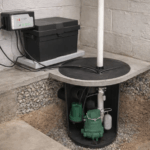
A sump pump is installed at the lowest point of a basement or crawl space, usually inside a pit dug into the floor. Its job is to collect water that builds up around the foundation, whether from rain, snowmelt, or rising groundwater, and push it safely away from the home.
How Sump Pumps Manage Groundwater in Chicago Homes
When water seeps into the sump pit and reaches a set level, a float switch activates the pump automatically. From there, collected water moves through a discharge pipe and gets routed away from the foundation toward a storm drain, dry well, or designated outdoor area.
In Chicago, where spring storms can drop several inches of rain in just a few hours, sump pumps work hard. Groundwater levels rise fast, and without a functioning pump, basements flood fast. The city’s Basement Flooding Partnership documents this as a significant, well-documented challenge for residents across many neighborhoods.
For homes in low-lying areas or those with older drainage infrastructure, a reliable sump pump isn’t optional. It’s essential. Reach out to us if you’re unsure whether your current setup is up to Chicago’s demands.
What a Sump Pump Cannot Handle
A sump pump is designed exclusively for clean or lightly contaminated groundwater. It has no capacity to handle human waste, toilet paper, or any solid material. The pump’s mechanics, discharge sizing, and pit design are all built for water, nothing else.
When homeowners mistakenly route wastewater into a sump pit, the outcome is predictable: clogs, motor burnout, and contamination that turns the entire system into a health risk. If your basement has a bathroom, laundry sink, or any drain tied into the home’s waste line, that water needs a completely different solution.
What Is a Sewage Ejector Pump and When Is It Required?
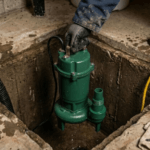
A sewage ejector pump is a wastewater pump for basement applications where plumbing fixtures sit below the main sewer line. Because gravity can’t move waste upward to the street-level connection, the ejector pump provides the mechanical force to push it there.
That’s what makes a sewage ejector pump for basement bathrooms so critical in homes with below-grade living space, which is common across Chicago’s older housing stock.
How Ejector Pumps Move Waste from Below-Grade Bathrooms
When a toilet flushes or a sink drains in a below-grade bathroom, waste flows into a sealed ejector pit. Once the level reaches a set point, the pump activates and forces everything up through a discharge pipe that connects to the home’s main drain line.
From there, it travels normally to the municipal sewer system. The ejector pump handles solids up to 2 inches, including waste, toilet paper, and gray water from sinks and showers.
The Sealed Ejector Pit: Code, Venting, and Why It Matters
Unlike a sump pit, which can often remain open, an ejector pit must be fully sealed with an airtight, gasketed lid. Sewage contains methane and hydrogen sulfide, both dangerous if they accumulate in an enclosed space. A sealed pit keeps those gases contained and routes them safely through a dedicated vent pipe connected to the home’s vent stack and out through the roof.
In most installations, a check valve is required to prevent waste from flowing back into the pit after the pump shuts off; however, in single-family residential buildings, only a check valve is required on the discharge piping rather than an additional gate valve.
None of this is optional. Chicago and Illinois plumbing codes require proper venting and sealed pit construction for ejector systems, and non-compliant installations can fail inspection or create genuine safety hazards. Plumbing work of this type typically requires permits and a licensed plumber under Illinois and local Chicago code requirements.
However, requirements can vary, so we always recommend verifying with your municipality or contractor. When evaluating basement plumbing options, the venting and containment setup deserves just as much attention as the pump itself.
Sewage Ejector vs Sump Pump: Key Differences Side by Side
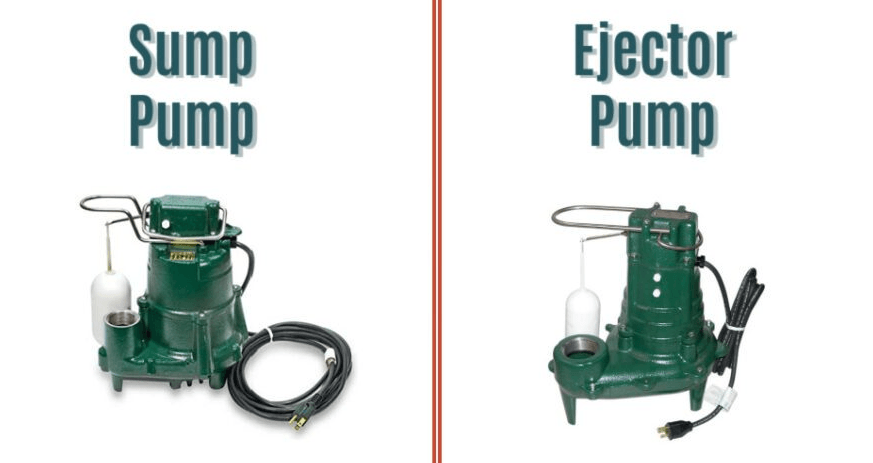
The difference between a sump pump and an ejector pump comes down to what each handles, how each is built, and where each connects within your plumbing system. The table below lays out the key distinctions clearly.
| Feature | Sump Pump | Sewage Ejector Pump |
|---|---|---|
| Primary Function | Removes groundwater/rainwater | Moves wastewater and solids |
| What It Handles | Clear/gray water only (no solids) | Liquids + solids up to 2″ (sewage, lint) |
| Common Location | Basement/crawl space sump pit | Below-grade bathroom/laundry basin |
| Discharge Destination | Outdoors/storm drain | Main sewer/septic line |
| Pit Design | Often open/grated, no vent required | Sealed, vented, with check valve |
| Power & Durability | Lighter, energy-efficient for water | Heavier-duty motor for solids |
| Activation | Float switch on water level | Float/level switch on wastewater |
One point that often causes confusion is how ejector pumps compare to grinder pumps. A grinder pump uses hardened cutting mechanisms to macerate waste before moving it and is typically used in community sewer systems where waste must travel longer distances. For most residential basement bathrooms in Chicago, a standard sewage ejector pump is the right call.
Why Chicago Basements Often Demand Both Systems
The sump and ejector pump combination is common in Chicago homes with finished or partially finished basements, and this isn’t redundancy. Each system handles something the other simply cannot.
If groundwater intrusion is your only issue, a properly sized sump pump may be all you need. If you’re adding a below-grade bathroom or laundry area where fixtures sit beneath the main sewer line, an ejector pump is required regardless of groundwater conditions.
But in a finished basement with both challenges, which many Chicago homeowners we work with are dealing with, both systems are necessary. The sump pump handles the groundwater that Chicago’s weather and clay-heavy soil push toward your foundation. The ejector pump handles the waste generated by anyone using the space.
During a heavy rainstorm, both pumps may be running at the same time, each doing a job the other can’t touch. If either one fails, the consequences are immediate. Both deserve equal attention and investment.
Sizing, Horsepower, and Why Pump Quality Is Non-Negotiable
Choosing the right capacity is an area where homeowners sometimes underestimate the stakes. An undersized sump pump will struggle during peak demand and burn out early. An undersized ejector pump may fail to push waste fully through the discharge line, causing backups directly into the basement.
For sump pumps, a 1/3 or 1/2 HP unit covers most residential situations. Homes with higher water tables, larger basements, or longer discharge runs may need more capacity. For sewage ejector pumps, 1/2 HP is a common starting point, though systems serving multiple fixtures or high-use households often warrant 1 HP or more, with commercial applications going up to 2 HP. Key sizing factors include basin volume, head height (the vertical lift required), flow rate in GPM, and solids-handling capacity.
Beyond horsepower, construction quality matters. Cast-iron housings dissipate heat better than thermoplastic alternatives and hold up under demanding conditions. Vortex impellers handle solids without clogging in ways that standard impellers can’t. Cutting corners on pump quality almost always means more frequent replacements and higher long-term costs, and Chicago’s storm intensity makes that especially true.
You can browse our plumbing products to see the commercial-grade options we carry from manufacturers trusted by trade professionals throughout the area.
Find the Right Pump for Your Chicago Basement at Allied PHS
What We Carry and Who We Serve
Allied Plumbing & Heating Supply Co. has served Chicago homeowners and trade professionals for over 30 years from our northwest Chicago showroom at 6949 W. Irving Park Rd. Our team understands the specific water management challenges that come with Chicago basements, from heavy clay soil and seasonal flooding to the demands of finished below-grade spaces.
Whether you need a reliable wastewater pump for basement drainage or a properly specified sewage ejector pump for a basement bathroom, we carry commercial-grade options from trusted manufacturers, backed by expert guidance that makes a real difference. Strong on-site product availability means getting the right system in place quickly is genuinely within reach.
Get Expert Help for Your Basement Setup
If you’re not sure whether your basement needs a sump pump, an ejector pump, or both, we’re here to help you figure that out. Browse our plumbing products to get a sense of what we stock, or contact our team directly to talk through your specific situation.
We’ll help you match the right equipment to your basement’s needs and make sure you leave with exactly what’s required.